Is It Illegal to Have Art With an American Flag on Fire
Controversial depictions of the US flag in art
(Image credit:
Metropolitan Museum of Art
)
As fence raged this week over the lowering of the Us flag, Kelly Grovier takes a wait at the profound meaning the symbol has taken in art history.
At that place's a selfless philosophy to flags. They raise others by allowing themselves to be brought low. By halting the hoist of a flag to 'half staff' (if in the U.s.a.) (or 'half mast' if on a ship or elsewhere in the world), a community signals that, in mourning, an emotional current of air has suddenly been sucked from its commonage sails – that grief has then sapped its forlorn muscle, no farther tug on the halyard, or rope, is possible.
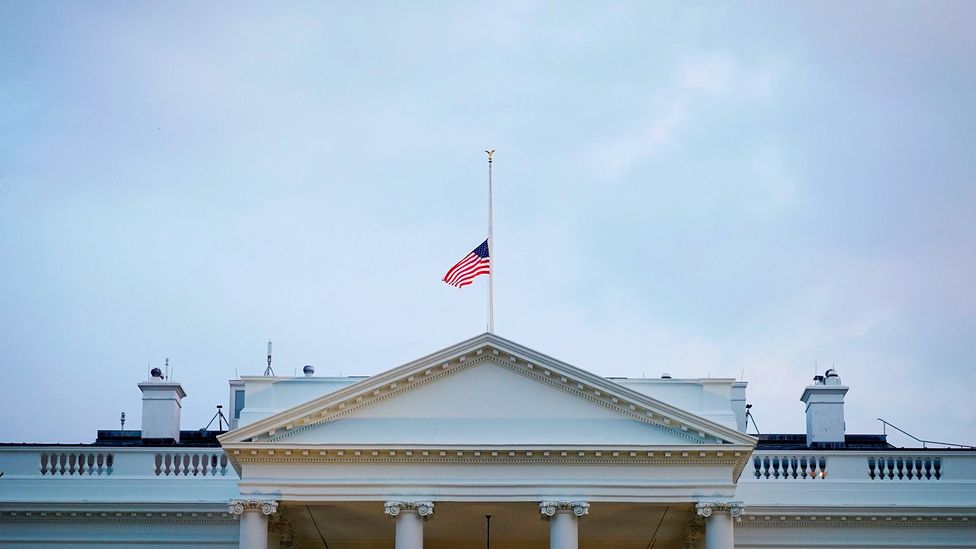
The US flag above the White House flies at half-mast (Credit: Getty Images)
The enduring profundity of the flag's philosophy was on total display this calendar week when the White House elected to lower, then raise, then lower again the Stars and Stripes following the death of US Senator John McCain – a former pow and Republican nominee for president. The vexing vexillology of the flag's positioning and repositioning, like a tedious-motion semaphore of conflicting emotion, absorbed the world.
- The rare blue the Maya invented
- The 17th Century artist who triumphed over her rape
- Eight Us flags that could have been
The flag's unexpected oscillation in the air infinite above the White House constituted a kind of provocative performance art that challenged observers' understanding of the very pregnant of the secular icon and its appropriate brandish. Every bit a potent prop, the The states flag has a long history of controversial appropriation past artists. Since its inception in 1777, the flag has routinely been seized upon by painters and sculptors keen to tap into its talismanic mystique. What follows are v of the almost arresting embodiments of the flag in fine art history – astonishing works that accept kept it firmly hoisted in pop imagination.
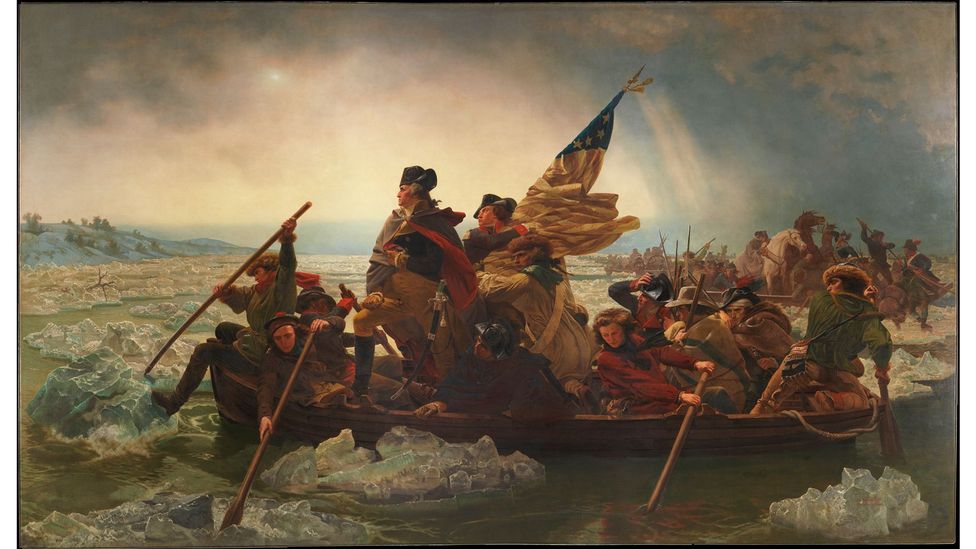
Washington Crossing the Delaware (1851) by Emanuel Leutze
Emanuel Leutze's Washington Crossing the Delaware (Credit: Metropolitan Museum of Art)
Some paintings are powerful in spite of themselves. German-American artist Emanuel Leutze'southward dramatic portrayal of General George Washington'due south stealthy nocturnal attack on the German Hessian forces at Trenton New Jersey in the wee hours of Battle Day 1776, is one of those. Created 75 years after the effect it ennobles, the famous painting refuses to allow historical or geographical fact to arrive the way of a riveting tableau. Although the flag it depicts spooled loosely at its centre would not exist designed for another year, few would deny the importance of Leutze's work in stitching the symbol tightly into the American psyche.
What Is the Proper Way to Display a United states Flag? (1988) past Dread Scott
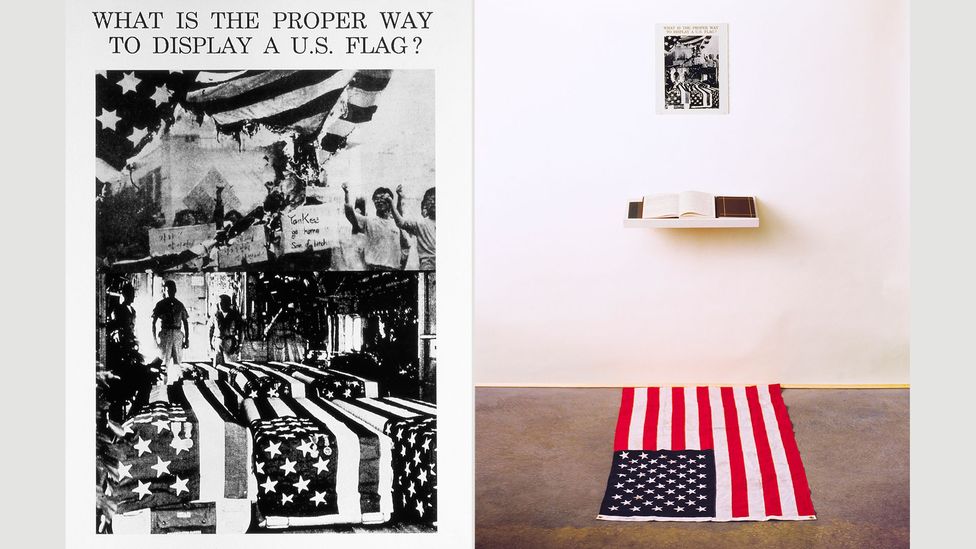
Dread Scott'due south What is the Proper Way to Display a United states of america Flag? (Credit: Dread Scott)
Few works of art accept ever dared observers to approach them every bit audaciously as US creative person Dread Scott's multimedia installation What Is the Proper Way to Brandish a Us Flag? Whatsoever gallery-goer wishing to inscribe a response to that question in the ledger that comprises part of the piece of work, or to get a better vantage on the collage of flag-draped coffins and flag-burning photos that is mounted above the ledger, must beginning contemplate walking across a flag that stretches, like a carpeting, in front of the installation. When displayed in 1989, Scott's bold booby-trap of a piece of work, which demanded observers decide what deference the flag deserves, caused a stir. So-president George H W Bush-league described the installation every bit "disgraceful" while some outraged lawmakers insisted information technology justified changing the very language of U.s.a. law to prohibit the desecration of what they believe is a sacrosanct symbol.
American Bog (Flag 1777) (2013) by Marker Alexander
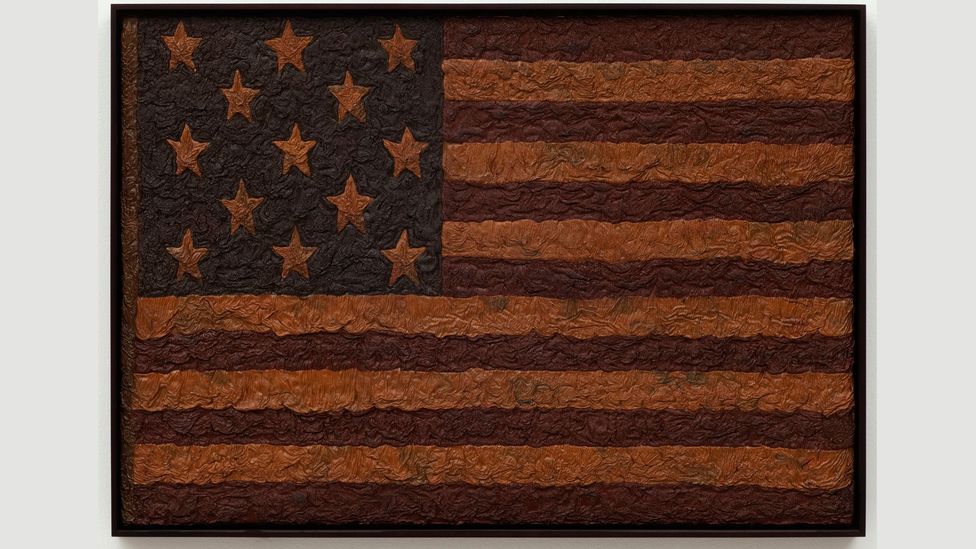
Mark Alexander'due south American Bog Series (Flag 1777). (Credit: Mark Alexander/ Photo by Peter White)
Rot has a brutal dazzler all of its own. That is the startling contention of British artist Mark Alexander's grungy, gorgeous serial of recent paintings that portend the future rediscovery of relics from a foretime America – every bit if salvaged from the sludgy depths of a prehistoric peat bog. Amid the totems seemingly drudged from the curative acids of Alexander's imaginary 'American Bog' is the original version of the Stars and Stripes, designed in 1777 – the one Leutze anachronistically wove into the centre of his famous riverscape, Washington Crossing the Delaware. By steeping that overly-familiar emblem of Americana in his iconoclastic soup, Alexander daringly dislocates a fatigued icon, forcing information technology to adopt a tougher second skin – i whose curdled complexion defies our ideas of slick prepare-made beauty. This is a flag that overcomes the disuse of its historical stains past becoming them – 1 that cannot be despoiled, because it already is.
White Flag (2015) by AA Bronson
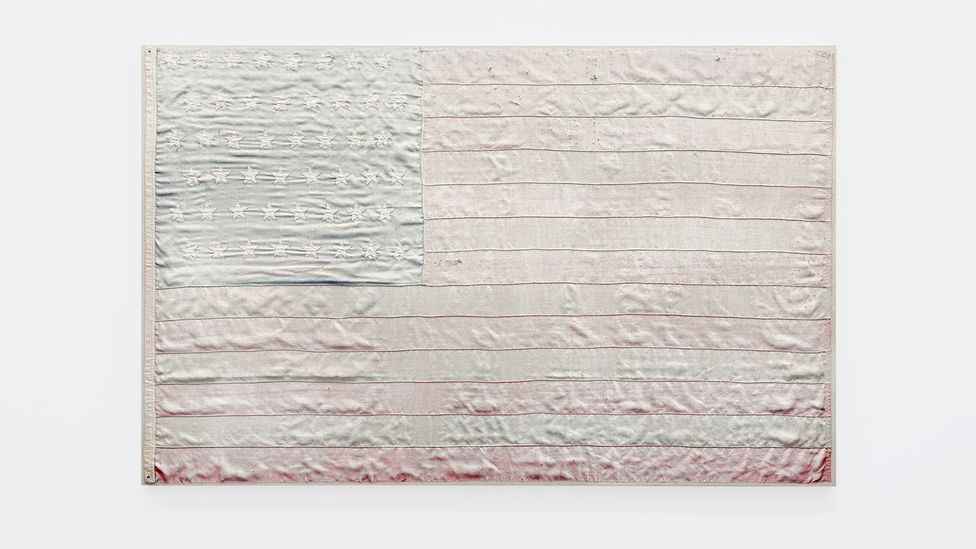
AA Bronson's White Flag #1 (Credit: AA Bronson, courtesy Maureen Paley, London)
Since antiquity, the waving of a white flag has signified surrender. In the hands of Canadian-born artist AA Bronson, that aboriginal archetypal symbol of capitulation has been redefined as an emblem of indomitable human fortitude. Recalling the bloodcurdling white veil of pulverised physical and glass that shrouded the streets of New York in the days following 9/11, Bronson recreates a semblance of the lethal motion-picture show that caked the metropolis where he lived and worked. Using an age-old concoction of chalk, rabbit pare mucilage, and love (historically employed as a canvass primer), the artist has turned the vivacity of the US flag'southward rich colours to a ghostly low. At get-go glance, Bronson'southward work may seem a pale allusion to Jasper John'south famous 1953 monochromatic Pop Art work by the same title. Look closer and i before long discovers that, dissimilar Johns's painting, inspired by a dream, Bronson's unsettlingly spectral vision is all as well existent in the palpable admixture of pain and perseverance it conjures.
Ghost Gun (2017) by Sean Scully
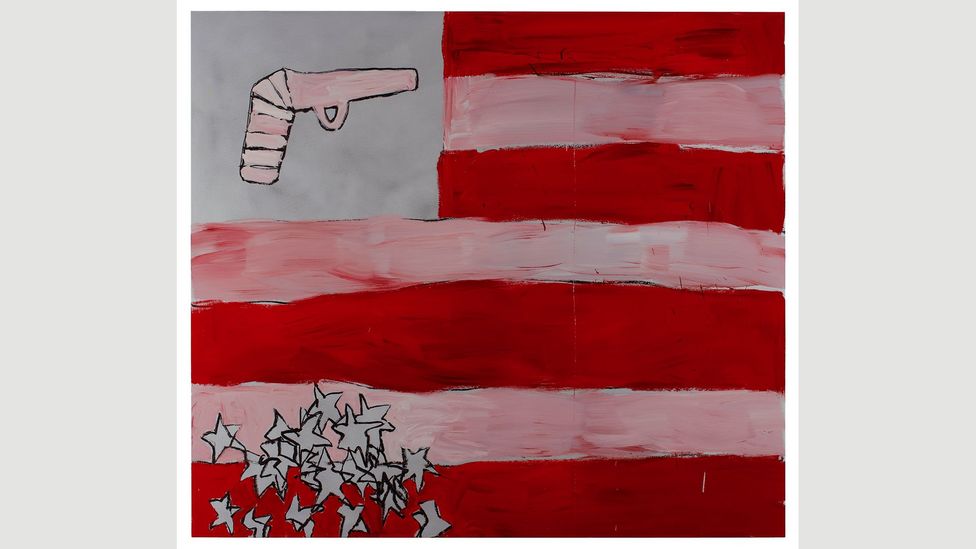
Sean Scully'southward Ghost Gun (Credit: Sean Scully, courtesy of the artist and Blain/ Southern, photo by Robert Bean)
Haunted by the horror of recurrent shootings in United states streets and schools, Ghost Gun by the Irish gaelic-American artist Sean Scully is a high-powered gut-slug of a painting. This is weapons-grade fine art. Known almost exclusively for his vibrant vocabulary of abstract stripes and abutting blocks of muscular colour, Scully, who lives and works in New York, has taken a courageous swerve into figurative art with Ghost Gun (part of a series of eight graphically-similar gun-wielding paintings) to chronicle anxieties about raising a child in a society where the correct to bear arms is constitutionally absolute. By swapping traditional linen canvas for metallic (aluminium) as the painting'south substructure, the creative person unweaves the fabric of the flag, alchemising it into the material of armament. Here, the stripes are non then much red-and-white equally blood-streaked and stained. The stars, once scintillating and symmetrical, are now shattered, crumpled in a heap, waiting to be swept away for expert.
If you would like to annotate on this story or annihilation else you lot have seen on BBC Civilisation, head over to our Facebook page or message us on Twitter .
And if y'all liked this story, sign up for the weekly bbc.com features newsletter , called "If You Only Read six Things This Week". A handpicked selection of stories from BBC Future, Culture, Capital and Travel, delivered to your inbox every Friday.
Source: https://www.bbc.com/culture/article/20180831-controversial-depictions-of-the-us-flag-in-art

Post a Comment for "Is It Illegal to Have Art With an American Flag on Fire"